
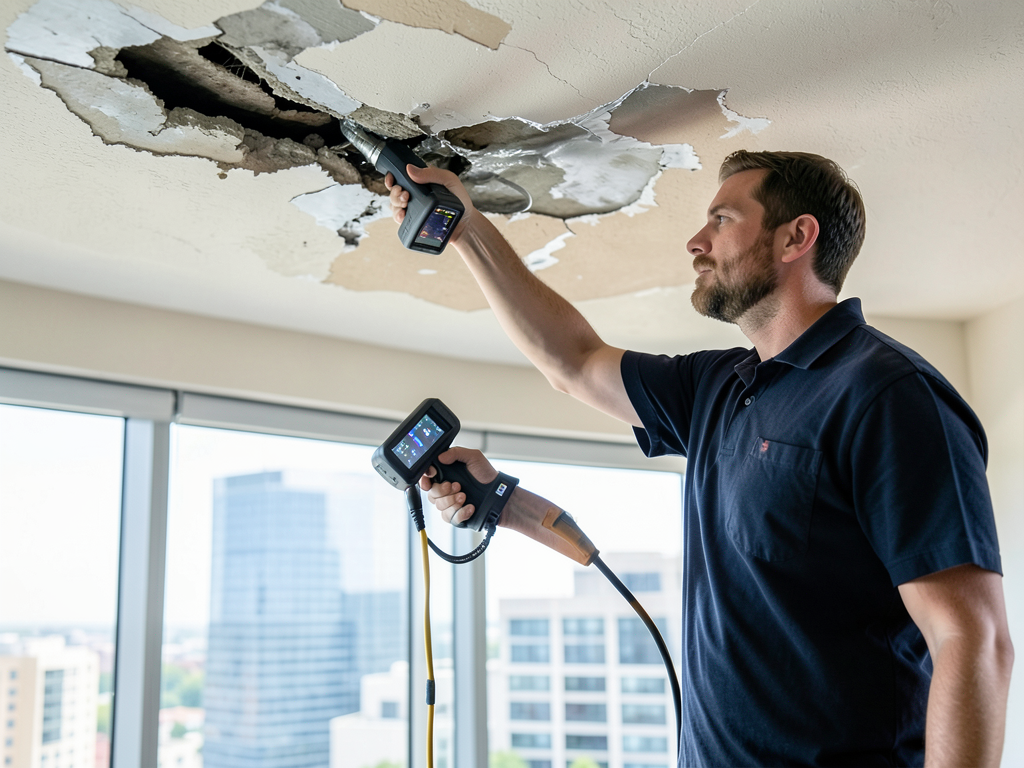
What to do if your neighbor’s plumbing leak is damaging your Uptown condo
When water starts dripping through your ceiling from the unit above, panic sets in fast. In Uptown Charlotte’s high-rise buildings, a neighbor’s plumbing leak can quickly turn into your expensive nightmare. Understanding who pays for the damage and what to do first can save you thousands of dollars and weeks of stress. Is a Tankless Water Heater Worth It for Your Ballantyne Home?.
North Carolina condo law creates a complex web of responsibility between unit owners, HOAs, and insurance companies. The source of the leak, the type of damage, and your HOA’s specific bylaws all determine who foots the bill. This guide breaks down exactly what to do when your neighbor’s plumbing fails and your property takes the hit.
Immediate steps to take when water is coming through your ceiling
Before worrying about legal responsibility, stop the damage from getting worse. Every minute counts when water is actively flowing. Signs You Need a Main Water Line Replacement in Pineville.
- Stop the water flow
Locate your unit’s main water shut-off valve immediately. In most Uptown high-rises, this is in a utility closet or near the water heater. If you can’t find it, contact building management right away.
- Document everything
Take photos and videos of all visible damage before anything is cleaned up. Capture water stains, bubbling paint, and any personal property damage. Time-stamp these photos if possible.
- Notify building management
Call your HOA or property management company immediately. Most Uptown buildings have 24/7 emergency lines. Request that they contact the unit above you to investigate the source.
- Protect your belongings
Move furniture, electronics, and valuables away from affected areas. Place buckets under active drips and use towels to contain spreading water.
The golden rule of condo plumbing: common elements vs. unit assets
Understanding the basic structure of condo ownership is crucial for determining responsibility. In North Carolina, the North Carolina Condominium Act (Chapter 47C) establishes that condo owners own their individual units but share ownership of common elements.
Common elements typically include:
- Building structural components
- Roof and exterior walls
- Shared plumbing stacks and main supply lines
- HVAC systems serving multiple units
Unit assets are everything inside your four walls, including:
- Interior plumbing fixtures and supply lines
- Electrical systems within your unit
- Personal property and improvements
- Floor, wall, and ceiling finishes
When a leak originates from a common element, the HOA’s master insurance policy typically covers structural repairs. When it comes from a unit asset, the responsible owner’s insurance should cover it. But determining the source isn’t always straightforward in Uptown’s older high-rises. EPA WaterSense.
North Carolina Condominium Act: How state law affects Uptown residents
The North Carolina Condominium Act Section 47C-2-119 specifically addresses maintenance and repair responsibilities. The Act requires HOAs to maintain, repair, and replace common elements, while unit owners maintain their individual units.
However, Section 47C-3-116 creates an important exception: if a unit owner’s negligence causes damage to common elements or another unit, they can be held financially responsible regardless of insurance coverage. Common Sewer Line Issues for Historic Dilworth Properties and How to Fix Them.
This means if your neighbor’s dishwasher supply line burst because they never replaced it despite knowing it was old and corroded, they could be liable for all resulting damages under North Carolina law.
Deciphering your HOA’s CC&Rs and bylaws
Your HOA’s Declaration of Covenants, Conditions, and Restrictions (CC&Rs) and bylaws create another layer of responsibility that often differs from state law minimums.
Most Uptown Charlotte HOAs include specific provisions about:
- Emergency response procedures for water damage
- Maintenance requirements for individual unit plumbing
- Insurance coverage requirements for unit owners
- Dispute resolution processes
For example, many Uptown buildings require unit owners to carry HO-6 policies that cover water damage originating from their unit, even if it affects common areas or other units.
Common leak scenarios in Uptown high-rises
Uptown Charlotte’s high-rise buildings present unique plumbing challenges that don’t exist in single-family homes. Understanding these scenarios helps determine responsibility quickly.
Vertical stack leaks occur when waste pipes running through multiple floors develop cracks or joint failures. These leaks can affect several units below before the source is identified. In buildings like The Vue or Avenue, these stacks are common elements maintained by the HOA.
Supply line failures happen when flexible hoses under sinks or behind toilets burst. These are typically unit owner responsibilities since they serve individual fixtures. However, if the main supply line serving your floor fails, that’s usually a common element issue.
HVAC condensate line backups are common in Uptown’s climate-controlled buildings. When condensate drains clog, water backs up into units below. The responsibility depends on whether the line serves multiple units or just one.
Water heater failures can flood entire units. In high-rises, water heaters are usually located in utility closets and are considered unit assets, making the owner responsible for maintenance and replacement.
The role of insurance: master policies vs. HO-6 policies
Understanding the difference between your HOA’s master insurance policy and your individual HO-6 policy is critical for knowing what gets covered.
| Coverage Type | Master Policy (HOA) | HO-6 Policy (Unit Owner) |
|---|---|---|
| Building Structure | ✓ Common elements and original construction | ✗ Interior walls, flooring, cabinets |
| Personal Property | ✗ | ✓ Furniture, electronics, clothing |
| Improvements/Upgrades | ✗ | ✓ Kitchen remodels, new fixtures |
| Loss of Use | ✗ | ✓ Hotel stays during repairs |
| Deductibles | Often $5,000-$25,000 | Typically $500-$2,500 |
Many Uptown condo owners discover too late that their HO-6 policy doesn’t cover flood damage or that their master policy deductible is so high it functions like no coverage at all.
Why Uptown Charlotte buildings have unique plumbing challenges
Uptown Charlotte’s high-rise condo market includes buildings constructed between the 1970s and today, each with distinct plumbing vulnerabilities.
Older buildings like 525 North Tryon (constructed in the 1980s) often have galvanized steel supply lines that corrode from the inside out. These pipes can fail catastrophically without warning, spraying water at high pressure for hours before anyone notices.
Mid-rise buildings from the 1990s frequently used polybutylene piping, which North Carolina now recognizes as defective. These gray plastic pipes become brittle with age and are prone to sudden failure under normal water pressure.
Newer luxury towers like The Trust Building have complex manifold plumbing systems with individual shut-off valves for each unit. While this allows for easier isolation of problems, it also means a single failed valve can affect your entire unit.
Uptown’s soil conditions also contribute to plumbing issues. Charlotte’s heavy clay soil expands and contracts with moisture changes, putting stress on underground plumbing connections that can eventually cause leaks in building foundations.
Documentation and insurance claims process
Proper documentation is essential for successful insurance claims in condo leak situations. Insurance adjusters need clear evidence of damage extent, source identification, and mitigation efforts.
Start by creating a detailed damage report that includes:
- Photos of all affected areas from multiple angles
- Moisture meter readings showing water migration patterns
- Receipts for any emergency services or repairs
- Communication records with your neighbor, HOA, and insurance companies
Most insurance companies require you to mitigate further damage immediately. This means you can’t just let water continue flowing while waiting for insurance approval. Keep all receipts for emergency plumbing services, as these are often reimbursable.
When filing claims, be prepared to provide:
- Proof of ownership and unit location
- Documentation of the leak source (plumber’s report)
- Estimates for repairs from licensed contractors
- Evidence that you took reasonable steps to prevent damage
When to call a professional plumber
While emergency mitigation is your first priority, professional leak detection becomes essential for determining responsibility and preventing future damage. Professional Toilet Repair and Installation Services in Matthews.
Call a licensed plumber immediately if:
- Water is actively flowing and you can’t locate the source
- You notice water stains spreading over time
- Your water meter shows usage when all fixtures are off
- You hear running water behind walls but can’t find the source
Professional plumbers use advanced leak detection equipment including thermal imaging cameras, acoustic listening devices, and moisture meters to pinpoint leak sources without destructive testing. Hidden Slab Leak Detection for Homeowners in South Park.
In Uptown’s high-rise buildings, plumbers often need to coordinate with building engineers to access mechanical rooms, roof areas, and other common spaces where plumbing infrastructure is located.
Preventing future neighbor leaks
After resolving an active leak, take steps to prevent future incidents that could damage your unit or your neighbor’s property.
Install water leak detection devices in key areas like under sinks, behind toilets, and near water heaters. These smart devices can shut off water automatically when leaks are detected and send alerts to your phone.
Schedule annual plumbing inspections to identify potential problems before they cause damage. A licensed plumber can check for pipe corrosion, fixture wear, and water pressure issues that might lead to future leaks.
Know your building’s plumbing layout. Understanding where your unit’s water lines run and how they connect to building systems helps you identify potential problem areas and communicate effectively with maintenance staff.
Consider upgrading older plumbing components. Flexible supply lines, angle stops, and other small components have limited lifespans and are common failure points in condo buildings.
Legal considerations and dispute resolution
When neighbor disputes over plumbing leaks can’t be resolved through insurance or HOA channels, North Carolina law provides several options.
Most Uptown HOAs require mandatory mediation before legal action can be taken. This process involves a neutral third party who helps both sides reach a voluntary agreement.
If mediation fails, small claims court handles disputes under $10,000, while larger claims require civil court proceedings. However, litigation is expensive and time-consuming, often costing more than the disputed damages.
Document everything from the beginning. Keep records of all communications, damage reports, repair estimates, and insurance correspondence. This documentation is crucial if legal action becomes necessary.
Consider hiring a lawyer specializing in North Carolina condo law if damages are significant or liability is unclear. Many offer initial consultations at reasonable rates.
Frequently Asked Questions
Who is responsible if my neighbor’s toilet supply line bursts and damages my ceiling?
Generally, your neighbor is responsible since the supply line serves only their unit. However, if the damage exceeds their insurance deductible, your HO-6 policy may need to cover repairs to your unit’s interior, with subrogation against your neighbor’s insurance afterward.
How long do I have to report water damage to my insurance company?
Most HO-6 policies require reporting within 14-30 days of discovery. However, prompt reporting is always best practice. Delays can give insurers grounds to deny claims based on failure to mitigate damages.
Can my HOA charge me for damage caused by my neighbor’s leak?
Generally no, if the damage originated from a specific unit. However, if the HOA’s master policy deductible applies and the HOA chooses to pass that cost to all owners, you might share in that expense regardless of fault.
What if the leak source can’t be determined?
When the source is unclear, insurance companies often invoke the “coincidence rule” and each party’s insurance pays for damage to their insured’s property. This is why thorough documentation and professional leak detection are so important.
Should I file a claim with my insurance if my neighbor is clearly at fault?
Yes. File with your insurance first to get repairs started quickly. Your insurer will then pursue the responsible party’s insurance through subrogation. This approach minimizes your out-of-pocket expenses and gets repairs moving faster.
Take action before the next leak happens
Water damage from a neighbor’s plumbing failure can cost thousands in repairs and create months of disruption to your Uptown lifestyle. Understanding your rights and responsibilities under North Carolina law, your HOA’s bylaws, and your insurance policies is your best protection.
Don’t wait until water is pouring through your ceiling to learn about condo plumbing responsibility. Review your HOA documents, check your insurance coverage, and know where your unit’s shut-off valves are located.
If you’re currently dealing with an active leak or want to prevent future damage, professional help is just a phone call away. Call (980) 342-9933 today to schedule a comprehensive plumbing inspection of your Uptown condo. Our licensed plumbers specialize in high-rise building systems and can identify potential problems before they become expensive disasters.
Pick up the phone and call (980) 342-9933 before the next storm hits. Your peace of mind is worth protecting.
{
“@context”: “https://schema.org”,
“@type”: “BlogPosting”,
“headline”: “What to do if your neighbor’s plumbing leak is damaging your Uptown condo”,
“description”: “Uptown Charlotte condo owners: Learn who pays for neighbor’s plumbing leaks under NC law, how to stop damage fast, and when to call a plumber. Call (980) 342-9933.”,
“wordCount”: 2055,
“datePublished”: “2026-06-07T15:36:00.000Z”,
“dateModified”: “2026-06-07T15:36:00.000Z”,
“inLanguage”: “en-US”,
“mainEntityOfPage”: {
“@type”: “WebPage”,
“@id”: “https://keystoneplumbingcharlotte.com”
},
“publisher”: {
“@type”: “LocalBusiness”,
“name”: “Keystone Plumbing Charlotte”,
“url”: “https://keystoneplumbingcharlotte.com”
},
“author”: {
“@type”: “Organization”,
“name”: “Keystone Plumbing Charlotte”,
“url”: “https://keystoneplumbingcharlotte.com”
},
“image”: {
“@type”: “ImageObject”,
“url”: “https://keystoneplumbingcharlotte.com/wp-content/uploads/2026/03/what-to-do-if-your-neighbor-s-plumbing-leak-is-dam-1.png”
}
}
{
“@context”: “https://schema.org”,
“@type”: “Plumber”,
“name”: “Keystone Plumbing Charlotte”,
“url”: “https://keystoneplumbingcharlotte.com”,
“address”: {
“@type”: “PostalAddress”,
“addressLocality”: “Charlotte”
},
“areaServed”: {
“@type”: “City”,
“name”: “Charlotte”
}
}
{
“@context”: “https://schema.org”,
“@type”: “FAQPage”,
“mainEntity”: [
{
“@type”: “Question”,
“name”: “Who is responsible if my neighbor’s toilet supply line bursts and damages my ceiling?”,
“acceptedAnswer”: {
“@type”: “Answer”,
“text”: “Generally, your neighbor is responsible since the supply line serves only their unit. However, if the damage exceeds their insurance deductible, your HO-6 policy may need to cover repairs to your unit’s interior, with subrogation against your neighbor’s insurance afterward.”
}
},
{
“@type”: “Question”,
“name”: “How long do I have to report water damage to my insurance company?”,
“acceptedAnswer”: {
“@type”: “Answer”,
“text”: “Most HO-6 policies require reporting within 14-30 days of discovery. However, prompt reporting is always best practice. Delays can give insurers grounds to deny claims based on failure to mitigate damages.”
}
},
{
“@type”: “Question”,
“name”: “Can my HOA charge me for damage caused by my neighbor’s leak?”,
“acceptedAnswer”: {
“@type”: “Answer”,
“text”: “Generally no, if the damage originated from a specific unit. However, if the HOA’s master policy deductible applies and the HOA chooses to pass that cost to all owners, you might share in that expense regardless of fault.”
}
},
{
“@type”: “Question”,
“name”: “What if the leak source can’t be determined?”,
“acceptedAnswer”: {
“@type”: “Answer”,
“text”: “When the source is unclear, insurance companies often invoke the \”coincidence rule\” and each party’s insurance pays for damage to their insured’s property. This is why thorough documentation and professional leak detection are so important.”
}
},
{
“@type”: “Question”,
“name”: “Should I file a claim with my insurance if my neighbor is clearly at fault?”,
“acceptedAnswer”: {
“@type”: “Answer”,
“text”: “Yes. File with your insurance first to get repairs started quickly. Your insurer will then pursue the responsible party’s insurance through subrogation. This approach minimizes your out-of-pocket expenses and gets repairs moving faster.”
}
}
]
}
{
“@context”: “https://schema.org”,
“@type”: “HowTo”,
“name”: “Emergency Leak Response”,
“step”: [
{
“@type”: “HowToStep”,
“position”: 1,
“name”: “Stop the water flow”,
“text”: “Locate your unit’s main water shut-off valve immediately. In most Uptown high-rises, this is in a utility closet or near the water heater. If you can’t find it, contact building management right away.”
},
{
“@type”: “HowToStep”,
“position”: 2,
“name”: “Document everything”,
“text”: “Take photos and videos of all visible damage before anything is cleaned up. Capture water stains, bubbling paint, and any personal property damage. Time-stamp these photos if possible.”
},
{
“@type”: “HowToStep”,
“position”: 3,
“name”: “Notify building management”,
“text”: “Call your HOA or property management company immediately. Most Uptown buildings have 24/7 emergency lines. Request that they contact the unit above you to investigate the source.”
},
{
“@type”: “HowToStep”,
“position”: 4,
“name”: “Protect your belongings”,
“text”: “Move furniture, electronics, and valuables away from affected areas. Place buckets under active drips and use towels to contain spreading water.”
}
],
“image”: “https://keystoneplumbingcharlotte.com/wp-content/uploads/2026/03/what-to-do-if-your-neighbor-s-plumbing-leak-is-dam-1.png”
}
{
“@context”: “https://schema.org”,
“@type”: “BreadcrumbList”,
“itemListElement”: [
{
“@type”: “ListItem”,
“position”: 1,
“name”: “Home”,
“item”: “https://keystoneplumbingcharlotte.com”
},
{
“@type”: “ListItem”,
“position”: 2,
“name”: “Blog”,
“item”: “https://keystoneplumbingcharlotte.com/blog”
},
{
“@type”: “ListItem”,
“position”: 3,
“name”: “What to do if your neighbor’s plumbing leak is damaging your Uptown condo”
}
]
}
{
“@context”: “https://schema.org”,
“@type”: “Service”,
“serviceType”: “Plumbing”,
“provider”: {
“@type”: “LocalBusiness”,
“name”: “Keystone Plumbing Charlotte”,
“url”: “https://keystoneplumbingcharlotte.com”
},
“areaServed”: {
“@type”: “City”,
“name”: “Charlotte”
},
“description”: “Uptown Charlotte condo owners: Learn who pays for neighbor’s plumbing leaks under NC law, how to stop damage fast, and when to call a plumber. Call (980) 342-9933.”
}